
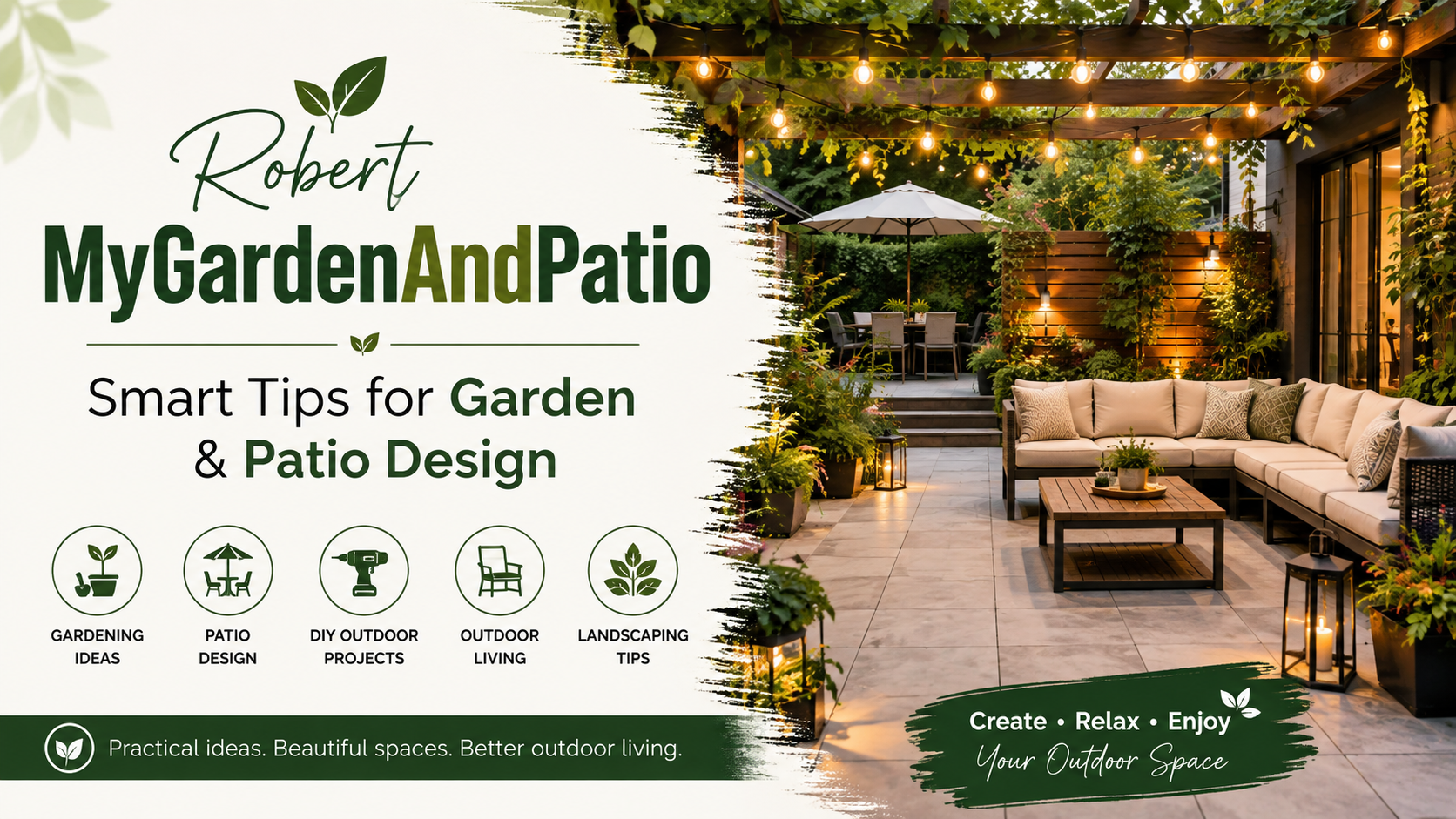
Robert MyGardenAndPatio is associated online with MyGardenAndPatio, a website covering gardening, patio design, DIY outdoor projects, furniture, landscaping, and outdoor living. The site’s About page identifies Robert Flower as the person behind the platform and describes his focus as gardening, landscaping, and outdoor design. Current posts on the site are still being published under Robert Flower, including an August 8, 2026 article about solar power for homes and backyards.
For anyone searching for Robert MyGardenAndPatio, the useful question is not simply who Robert is. It is how the ideas associated with the site can be translated into a garden and patio that looks good, works well, handles weather, and does not become unnecessarily expensive or difficult to maintain.
What Is Robert MyGardenAndPatio?
MyGardenAndPatio presents itself as an outdoor-living information website. Its stated mission is to provide practical DIY advice for gardens and homes along with product reviews. The website covers topics ranging from planting and garden care to patios, gazebos, fences, outdoor furniture, lighting, and broader backyard improvements.
The name Robert MyGardenAndPatio appears in search results as shorthand for the person associated with this content. However, there is an important distinction between what the website says about itself and what can be independently verified.
The site’s About page identifies Robert Flower as its founder and describes him as an experienced gardener and outdoor enthusiast. That same page was last modified in August 2023, while newer website content continues to carry Robert Flower’s name. This supports an ongoing connection between Robert Flower and the site, but it does not by itself establish professional licensing, formal horticultural qualifications, or independent certification.
That distinction matters when using online gardening advice. Good design principles can be supported by horticultural and environmental organizations even when the credentials of an individual online author are difficult to verify independently.
What Does MyGardenAndPatio Focus On?
The site’s subject matter is broad, but several themes appear repeatedly.
| Area | What readers can learn |
|---|---|
| Garden design | Layout, planting ideas, garden styles and space planning |
| Patio design | Outdoor seating, materials, lighting and functional layouts |
| DIY projects | Practical projects for improving outdoor areas |
| Plant selection | Choosing plants according to space, sunlight and growing conditions |
| Outdoor living | Furniture, gazebos, entertainment areas and backyard comfort |
| Sustainable gardening | Water efficiency, greener materials and lower-maintenance approaches |
| Home and yard improvements | Fencing, storage, landscaping and related exterior projects |
This combination is useful because a successful outdoor space rarely depends on one decision. The patio affects movement through the garden. Planting affects shade and privacy. Hard surfaces affect drainage. Furniture determines how much of the space can actually be used.
A garden can therefore be attractive in photographs while still being frustrating in everyday life. Good outdoor design begins with function, then builds visual appeal around it.
The Smartest Garden Design Tip: Plan Before You Build
One of the strongest ideas supported by professional garden-design guidance is simple: make a plan before changing the landscape.
The Royal Horticultural Society recommends measuring the garden, recording its shape, noting existing features and observing where sunlight falls. A scaled plan can also help estimate how much paving, soil, edging or other material will actually be required. Changing a design on paper is much easier than removing a finished path or rebuilding a patio.
Before buying anything, map out:
- The house, doors and windows
- Existing trees and mature plants
- Areas receiving full sun and shade
- Existing paths and drainage routes
- Patio or seating locations
- Utility features that must remain accessible
- Places where water collects after rain
- Storage and maintenance access
This process often reveals a problem that is invisible when someone looks only at the appearance of an empty yard.
For example, a homeowner might place a large patio at the far end of the garden because it looks attractive on a sketch. But if most trips outside involve carrying food from the kitchen, a patio closer to the house may be much more practical.
Design Around How You Actually Use the Space
A patio should not be positioned simply because it fits.
Think about what the space needs to do. A dining patio requires room for chairs to move behind people sitting at the table. A lounge area needs comfortable circulation around furniture. A family garden may need an open section for play rather than filling every available metre with beds and decoration.
The best layouts create a natural relationship between the house, patio, pathways and planting areas.
RHS garden-planning guidance similarly recommends thinking about the purpose of the area before selecting design elements. A border intended for wildlife, privacy, low maintenance or seasonal color will require different planting decisions.
A practical layout often includes:
A primary destination, such as a dining area or seating zone.
A clear route, allowing people to move without walking through planting beds.
Secondary spaces, such as a herb garden, fire area, storage corner or quiet seating spot.
Visual connections, so the garden still looks attractive when viewed from inside the house.
This is one of the most useful principles associated with smart outdoor planning: design for everyday movement rather than for a photograph.
Choose Plants for the Site, Not Just for Appearance
Plant selection is one of the easiest places to make an expensive gardening mistake.
A plant may look perfect at a nursery but struggle when placed in the wrong sunlight, soil, moisture level or climate. RHS guidance emphasizes selecting plants that suit the specific conditions and style of the garden. Its sustainable planting resources also highlight the value of matching plants to their location to reduce the need for additional water and fertilizer while supporting biodiversity.
Before choosing plants, consider:
| Condition | Question to ask |
|---|---|
| Sunlight | Does this position receive full sun, partial shade or deep shade? |
| Soil | Is it clay, sandy, fertile, compacted or poorly drained? |
| Moisture | Does water remain after rain or does the area dry rapidly? |
| Climate | Is the plant suited to local temperatures and seasonal conditions? |
| Size | How large will the plant become when mature? |
| Maintenance | Will it require frequent pruning, watering or feeding? |
Gardeners in the United States can also use the USDA Plant Hardiness Zone system as a broad guide to winter temperature suitability. It is based on average annual extreme minimum temperatures, so it is useful for cold-hardiness planning, but it should not be treated as the only factor in deciding whether a plant will thrive.
Microclimate matters too. A wall can create a warmer pocket, while a shaded corner can remain cool and damp. Wind exposure can also make an otherwise suitable plant perform poorly.
Use Layers to Make a Small Garden Feel Larger
Small gardens do not need to be filled with large numbers of plants to look impressive.
One better approach is to create vertical layers. Trees and taller shrubs provide height. Medium plants create structure. Groundcovers and lower perennials occupy the foreground.
RHS guidance specifically notes that urban gardens can make greater use of the vertical plane through climbers and other plants that use walls, fences and limited space efficiently.
This technique can work particularly well around patios. A climbing plant against a trellis can soften a wall without consuming much floor space. Containers can introduce plants where conventional beds are impractical. Taller planting can also create privacy without requiring a wide hedge.
The goal is not to make every surface green. It is to use height intelligently while preserving usable floor space.
Create a Strong Connection Between Patio and Garden
A patio can easily look like a separate construction project dropped into a garden. The transition becomes more convincing when hard and soft landscaping are designed together.
For example, planting can soften the edge of paving rather than stopping in a rigid straight line. The same material or color can be repeated elsewhere in the garden to create visual continuity. Containers, raised beds or low borders can also bridge the gap between patio furniture and surrounding greenery.
RHS design guidance identifies formal gardens, contemporary gardens and other styles through their use of geometry, materials, planting structure and repetition. Contemporary spaces, for instance, often rely on clean lines and restrained planting rather than excessive decoration.
The key lesson is consistency. You do not need an expensive landscape makeover to create it.
Think Carefully About Patio Drainage
One of the least glamorous parts of patio design is also one of the most important.
Impermeable surfaces can increase runoff because rain cannot infiltrate the ground as easily. University of Minnesota Extension guidance notes that patios and other hard surfaces can contribute to excess runoff, while Penn State Extension recommends considering porous or permeable paving for decks, patios and paths where site conditions allow.
That means patio design should consider where rainwater will go, not just where furniture will sit.
Possible strategies include:
- Permeable paving where appropriate
- Planting areas that can receive controlled runoff
- Properly designed drainage channels
- Rain gardens
- Rainwater collection
- Carefully graded surfaces
A rain garden can be especially useful in suitable locations because it is designed to capture runoff and allow it to infiltrate into the ground. Penn State Extension describes rain gardens as shallow planted depressions that can collect water from roofs, patios, driveways and other surfaces.
However, drainage design should never be copied blindly from another property. Soil, slope, rainfall, groundwater and local regulations all affect the correct solution.
Do Not Ignore the Direction of Water
Drainage mistakes can cause more than puddles.
Water should not be directed toward areas where it could damage buildings or create erosion. Official building guidance in England, for example, recommends designing gradients on impervious paved surfaces so water drains efficiently and warns against directing water toward buildings where it could cause damage. Local standards vary by jurisdiction, but the general engineering principle is widely applicable: plan the drainage route before laying the paving.
For a complex patio, retaining wall or sloped property, professional design may be worthwhile. The cheapest installation is not necessarily the cheapest project if poor drainage later requires demolition and reconstruction.
Make Watering More Intelligent
Water management is becoming increasingly important in garden design.
The U.S. Environmental Protection Agency recommends efficient irrigation practices and technologies, including irrigation controllers that can respond to weather or soil-moisture conditions. The EPA also recommends rain sensors and other measures to avoid watering unnecessarily.
For a residential garden, a smart watering strategy can be as simple as:
- Group plants with similar water requirements.
- Improve soil so it can retain moisture where appropriate.
- Use mulch in suitable planting areas.
- Water according to plant needs and weather rather than a rigid calendar.
- Consider drip or other targeted irrigation for beds.
- Inspect irrigation systems for leaks and overspray.
This is more effective than simply installing a larger irrigation system.
Consider Permeable Materials Where They Make Sense
A patio does not have to be completely sealed.
Permeable or porous hardscapes can allow more rainfall to enter the ground rather than immediately becoming surface runoff. University of Maryland Extension specifically recommends considering permeable materials when replacing or constructing patios, walkways and driveways.
That does not mean permeable paving is automatically the right answer everywhere. Soil permeability, drainage capacity, local rainfall, groundwater conditions, construction quality and maintenance all matter.
The smart decision is therefore not “always use permeable paving.” It is “understand how the chosen surface will handle water before construction begins.”
Use Shade as Part of the Design
A garden becomes more comfortable when shade is planned rather than treated as an accident.
Trees, pergolas, umbrellas and carefully positioned structures can change how a patio feels during hot parts of the day. Shade can also affect plant selection and create microclimates across the garden.
This is particularly important for patios used in the afternoon. A west-facing seating area may receive intense late-day sun, while a location near mature trees could become cooler but much darker.
Before permanently placing seating, observe the area at different times. Morning, midday and late-afternoon conditions can be dramatically different.
Keep the Patio Comfortable Without Overdecorating It
A practical patio usually needs fewer things than people expect.
Start with the fundamentals:
Comfortable seating.
Choose furniture according to how the area will actually be used.
Lighting.
Layer ambient, task and pathway lighting instead of relying on one bright fixture.
Shade.
Provide protection from harsh sun where required.
Storage.
Keep cushions, gardening tools and frequently used items accessible but organized.
Planting.
Use greenery to soften hard edges without blocking movement.
The strongest designs often look calm because they avoid filling every empty area. RHS guidance on contemporary garden design similarly emphasizes restraint, repeated patterns and a limited selection of plants and colors.
Make Privacy Work for You
Privacy is often more useful when it is layered.
A tall fence can provide a strong boundary, but plants can make that boundary feel softer. Trees and shrubs can block selected sightlines without turning the entire garden into a visual wall.
Privacy planting can also serve multiple functions. A tree can provide shade and habitat while screening a neighbor. A climber can soften a fence while adding seasonal interest.
Before installing a privacy feature, identify exactly where the unwanted view comes from. Screening every direction may waste money and valuable garden space.
Choose Materials With Maintenance in Mind
A beautiful material is not automatically a practical material.
Patio surfaces differ in their resistance to staining, weathering, algae, movement, cracking and general wear. Furniture also has different maintenance requirements depending on its construction and exposure.
Consider the following before making a purchase:
| Decision | Practical question |
|---|---|
| Patio surface | Will it become slippery, stained or difficult to clean? |
| Furniture | Can it remain outdoors in local conditions? |
| Wood | What maintenance and protection does it require? |
| Stone | Does the surface suit the intended use and climate? |
| Outdoor fabric | Can cushions be stored easily? |
| Lighting | Are fixtures rated for outdoor exposure? |
| Planting | Can mature plants be maintained without constant pruning? |
A lower-maintenance design may cost slightly more initially but save time over several years.
Use Sustainable Gardening as a Design Principle
Sustainability is not limited to buying “eco-friendly” products.
A genuinely sustainable garden often begins with appropriate planting, healthy soil, efficient watering and careful material choices.
RHS research-based planting guidance connects good plant selection with lower external inputs, improved soil health, biodiversity and reduced reliance on water and fertilizer.
Penn State Extension also recommends practices such as reducing runoff, using compost to improve moisture retention, applying mulch appropriately, using targeted irrigation and planting trees and other vegetation to manage stormwater.
That makes sustainability practical rather than cosmetic.
A well-planned garden can simultaneously improve appearance, reduce maintenance and handle environmental conditions more effectively.
When Robert MyGardenAndPatio Advice Is Most Useful
The material associated with MyGardenAndPatio can be useful for homeowners who are still working out what they want to do with an outdoor space. The website offers ideas covering garden design, patio improvements, DIY projects and outdoor living, which can help readers generate possibilities before beginning a project.
It is particularly useful as an inspiration source for questions such as:
- How can a small patio feel more comfortable?
- Which plants fit a particular garden style?
- How should seating be arranged?
- What can be built or improved as a DIY project?
- How can a garden connect better with the house?
- Which outdoor features deserve priority?
The best approach is to combine inspiration from such sites with guidance from horticultural organizations, extension services, environmental agencies and local authorities when decisions involve drainage, structural work, plant suitability or regulations.
What Readers Should Verify Before Following Online Advice
Not every garden recommendation is universal.
A planting suggestion that works in one climate may fail in another. A patio drainage approach that is suitable for one soil type may be inappropriate elsewhere. Building rules can also differ substantially between cities, states and countries.
There is another reason to evaluate online product recommendations carefully. MyGardenAndPatio says it provides product reviews, so readers should distinguish between a general opinion, personal experience and independently verified product performance. Where affiliate relationships exist, the U.S. Federal Trade Commission says disclosures should be clear and conspicuous, positioned where readers can understand the connection between the recommendation and the commercial relationship.
This does not mean an affiliate recommendation is automatically unreliable. It simply gives readers important context when evaluating purchasing advice.
Robert MyGardenAndPatio: What Can Actually Be Verified?
The strongest verifiable connection is straightforward. MyGardenAndPatio.com identifies Robert Flower as the founder and author associated with the site, and the website continues to publish articles under that name in 2026.
There are also multiple websites using variations of the “Robert MyGardenAndPatio” name. Some publish articles that describe Robert or the site in much stronger terms, but those descriptions should not automatically be treated as independent evidence of his credentials or business history. For example, third-party pages describe extensive experience and specific accomplishments that are not independently substantiated by the primary site’s About page.
For that reason, the most responsible interpretation is to view Robert MyGardenAndPatio as an online gardening and outdoor-living identity associated with Robert Flower and MyGardenAndPatio.com, while checking important technical or professional claims against independent sources.
A Practical Robert MyGardenAndPatio-Inspired Design Checklist
Before starting a garden or patio project, work through the basics in this order:
- Define the purpose. Decide whether the space is primarily for dining, relaxation, gardening, entertaining, children, pets or a mixture.
- Measure the site. Record boundaries, doors, windows, existing plants, structures and major obstacles.
- Observe sunlight. Check the garden throughout the day before choosing plants or placing permanent seating.
- Study water movement. Identify where rain naturally flows and where puddles form.
- Choose plants for the conditions. Match plants to sunlight, soil, moisture and climate rather than choosing only for appearance.
- Plan circulation. Make sure people can move comfortably between the house, patio, garden and storage areas.
- Select materials carefully. Consider durability, maintenance, drainage and long-term performance.
- Add shade and lighting. Improve comfort and usability without overcrowding the space.
- Allow for plant growth. Design around mature dimensions rather than nursery-size plants.
- Build in stages. Complete essential infrastructure first, then add decorative features as the space proves what it needs.
Frequently Asked Questions
Who is Robert MyGardenAndPatio?
The name refers online to Robert Flower and the MyGardenAndPatio platform. The site’s own About page identifies Robert Flower as its founder and describes his focus on gardening, landscaping and outdoor living.
What is MyGardenAndPatio about?
MyGardenAndPatio is an outdoor-living website covering gardening, patio design, DIY projects, outdoor décor, landscaping and product reviews. Its current content continues to address garden and backyard improvement topics.
Are Robert MyGardenAndPatio’s gardening tips reliable?
Some of the general design principles align with guidance from established organizations such as the Royal Horticultural Society, EPA and university extension programs. However, readers should independently verify technical, structural, regulatory and climate-specific recommendations rather than assuming every online tip applies universally.
What is the best starting point for a garden redesign?
Start by measuring the space, observing sunlight and water movement, and deciding how the area will be used. A scaled plan can prevent expensive changes later.
How can I make a patio more sustainable?
Reduce unnecessary hard surfaces where practical, consider appropriate permeable materials, manage runoff, use efficient irrigation and select plants suited to local conditions. Penn State and University of Maryland Extension both recommend approaches that reduce runoff and improve water management in residential landscapes.
Should every garden use native plants?
Native plants can offer important ecological and practical advantages, but plant choice should still reflect the specific site and design goals. Soil, sunlight, moisture, mature size and climate all matter. A well-designed planting scheme is about matching the right plant to the right place, not following one rule for every garden.
Is MyGardenAndPatio a professional landscaping company?
The website presents itself primarily as an information and advice platform and says it provides DIY guidance and product reviews. The available primary-page evidence does not establish it as a universally licensed landscaping contractor or professional design firm, so readers should verify any contractor, structural or installation credentials separately.
Also Read: How Is Mogothrow77 Software Installation? Setup, Safety & Tips
The Real Lesson Behind Robert MyGardenAndPatio
The most useful idea behind the Robert MyGardenAndPatio search term is not a particular furniture set, plant or decorative trend. It is the broader principle of treating a garden and patio as one connected living space.
Good design starts with how people move, where sunlight falls, how water behaves and which plants can actually thrive. From there, materials, furniture, planting and decoration can be added with a clear purpose.
That approach also holds up better than chasing short-lived backyard trends. A patio that drains properly, comfortable seating that gets used, plants matched to their environment and a layout that fits everyday life will usually provide more value than an expensive makeover designed only to look impressive on day one.
Robert MyGardenAndPatio is best understood as an inspiration and information resource, while the most important technical decisions should be checked against authoritative horticultural, environmental and local building guidance. That combination gives homeowners something much more useful than a picture-perfect backyard: an outdoor space that works in the real world.
Pingback: Tech Guru WaveTechGlobal | What It Is and What the Evidence Shows