
Peter Thiel and Kevin Hart: Investing in Ideas and Audiences
November 11, 2026 · Editorial-Networks
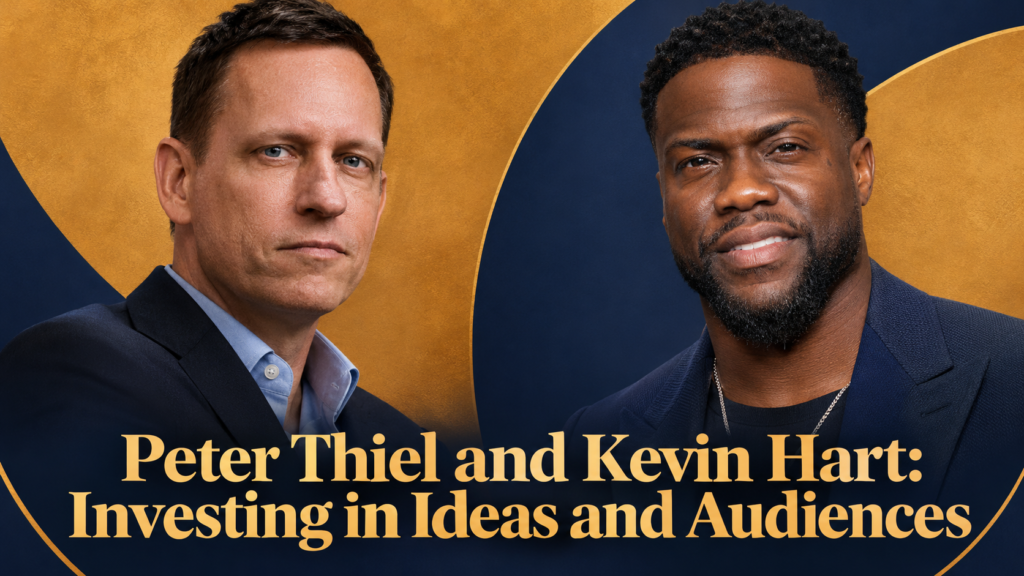
Peter Thiel and Kevin Hart are associated with different routes to building a business: Thiel with founding and financing technology companies, and Hart with performance and entertainment production. The sources reviewed here do not establish a joint venture. Their comparison is useful for understanding how capital, intellectual property and audiences contribute to different kinds of enterprise.
The central distinction is between investing in a company and creating work for an audience. These activities can overlap, but they do not mean the same thing. An investor’s financial interest, a performer’s contract and a founder’s ownership stake each create different rights and responsibilities. A meaningful comparison explains those arrangements rather than relying on celebrity or wealth rankings.
Peter Thiel and Kevin Hart: the verified starting points
Founders Fund’s Thiel biography identifies his involvement in PayPal, Palantir and venture investment. These are separate professional relationships, not one company. Co-founding a business, leading it as an executive and investing in another enterprise are different activities even when the same person has done all three.
Hartbeat’s own company account places Kevin Hart within a business producing entertainment across multiple formats. This adds an organisational dimension to his public identity as a performer. A production company involves teams, development and commercial partners as well as the person whose name makes the company recognisable.
What venture investment actually contributes
A growing company may seek capital to develop a product, hire people or expand its operations. Investors provide money under particular terms in exchange for rights that depend on the agreement. Those terms can affect ownership and governance. A public announcement of investment is therefore the beginning of a financial explanation, not the whole story.
The investor also takes risk. A promising idea may fail to become a viable business, and a viable business may not deliver the return expected at the price paid. Evaluating an investment requires attention to the company, the terms and the time horizon. A famous investor’s involvement is relevant context, but it is not a guarantee of future performance.
It is useful to distinguish the individual from the investment firm too. A firm may manage money belonging to several investors and make decisions through an organised process. Its assets are not automatically the personal assets of its most recognisable partner. Readers should identify who supplied the capital and which entity holds the interest.
What entertainment production actually contributes
A performer creates work an audience can watch or hear. A production business develops the systems around that work: projects, teams, financing, rights and distribution relationships. The public face can attract attention, but the company needs the ability to deliver finished material. A production announcement does not by itself establish that every planned project will be made.
Netflix’s announcement of its HartBeat Productions agreement documents a specific commercial relationship. The source is useful because it identifies the organisations and the kind of arrangement being announced. It should not be expanded into claims about unrelated investors or every business associated with Hart.
Rights are particularly important in entertainment. The person appearing on screen may not own the underlying project, while a production company may have interests that differ from a distribution partner’s. Contracts determine the arrangement. A viewer can recognise a star without knowing how the revenue or ownership is divided behind the scenes.
Ideas and audiences solve different problems
A technology venture needs a product that solves a problem for users or customers. An entertainment project needs work that an audience wants to experience. Both require execution, but the criteria for usefulness can differ. A business tool may be judged by how well it supports a task; a comedy performance may be judged by its effect on the audience.
Neither starts from attention alone. A compelling pitch can help secure a meeting or funding, but the product must still be built. A recognisable performer can help a project become visible, but the finished work must still hold interest. The difference between the promise and the delivered experience is a useful test across both fields.
The audience or customer is not passive in this process. People decide whether to use, recommend, buy or return to the offering. Their needs can change, and different groups can respond differently. A strong profile explains the particular market rather than treating popularity as a single universal measure.
The founder story can hide the organisation
Business narratives often centre on a decisive individual because that makes a complicated institution easier to describe. The simplification can be useful, but it can also erase collaborators, employees and partners. Founding a company is significant without meaning that every later achievement belongs to the founder alone.
This matters for both Thiel and Hart. A technology company involves technical, commercial and operational work by many people. An entertainment company involves creative and production work beyond its most visible performer. A fair comparison recognises individual contributions while keeping the wider organisation in view.
What a funding headline does not tell us
A funding amount can describe money entering a company, a purchase of an existing interest or another arrangement. These are not identical events. The valuation attached to a transaction also does not mean the company has that amount in cash. Readers should examine what was actually agreed before interpreting the number.
Likewise, a movie’s receipts or a show’s audience do not establish a performer’s personal earnings. Costs, distribution terms and contracts affect the financial outcome. A precise net-worth comparison would require personal assets and liabilities at a stated date. This article does not claim that the sources used provide a complete financial account for either individual.
How to evaluate claims about influence
Ask what action is being described and what evidence shows its effect. Investing in a business, speaking publicly and appearing in a project are different forms of participation. The article should identify which occurred, when it occurred and what can be established about the result. A general reputation for influence is not enough.
Readers should also distinguish analysis from reporting. This article compares two kinds of enterprise; it does not report that Thiel and Hart have adopted the same philosophy or worked together. Shared words such as “founder” and “entrepreneur” can introduce useful questions without proving a shared method.
Khatrimazacool’s guides to popular-culture discussion and online story communities offer related context on audience interpretation. They are not evidence of an affiliation involving either person or their businesses.
A further distinction is the route by which a return is realised. An ownership interest may be valued on paper without a sale occurring, while a production can generate receipts under a distribution agreement. Neither event should be described as personal cash income without the relevant evidence. Asking whether a number is a valuation, revenue, profit or an actual payment often resolves confusion before a comparison begins. The financial category should remain visible in the headline, table and explanation, rather than appearing only in a small qualification later in the article.
Frequently asked questions
Are Peter Thiel and Kevin Hart business partners?
The sources reviewed here do not establish a joint venture. Their separate public careers are compared analytically.
What is Peter Thiel known for in business?
Founders Fund’s biography identifies his involvement with PayPal, Palantir and venture investment. Those activities should be described as distinct roles.
What is Hartbeat?
Hartbeat describes itself as an entertainment business associated with Kevin Hart and work across multiple formats.
Does a valuation equal cash held by a company?
No. A valuation expresses a financial assessment under particular terms. It is different from the amount of cash in the business.
Does this article recommend an investment?
No. It explains business roles and evidence. A public figure’s participation does not establish that a particular investment is suitable or safe for a reader.
Leave a Reply