
The Cadillac LYRIQ’s driving modes can influence real-world energy consumption, but they do not give the SUV separate official range ratings or change the physical capacity of its battery. Cadillac’s 2026 LYRIQ offers Tour, Sport, Snow/Ice and My Mode, with each setting changing aspects of vehicle behavior rather than creating a different battery pack or fixed mileage figure.
That distinction is important. A LYRIQ driven gently in Sport can use energy differently from the same vehicle driven aggressively, while Tour is designed for smooth everyday driving and Snow/Ice modifies the vehicle for traction. Cadillac also makes clear that its high-performance Velocity Max function on the LYRIQ-V can reduce range with extended use, making it the clearest example of a performance setting having a direct range consequence.
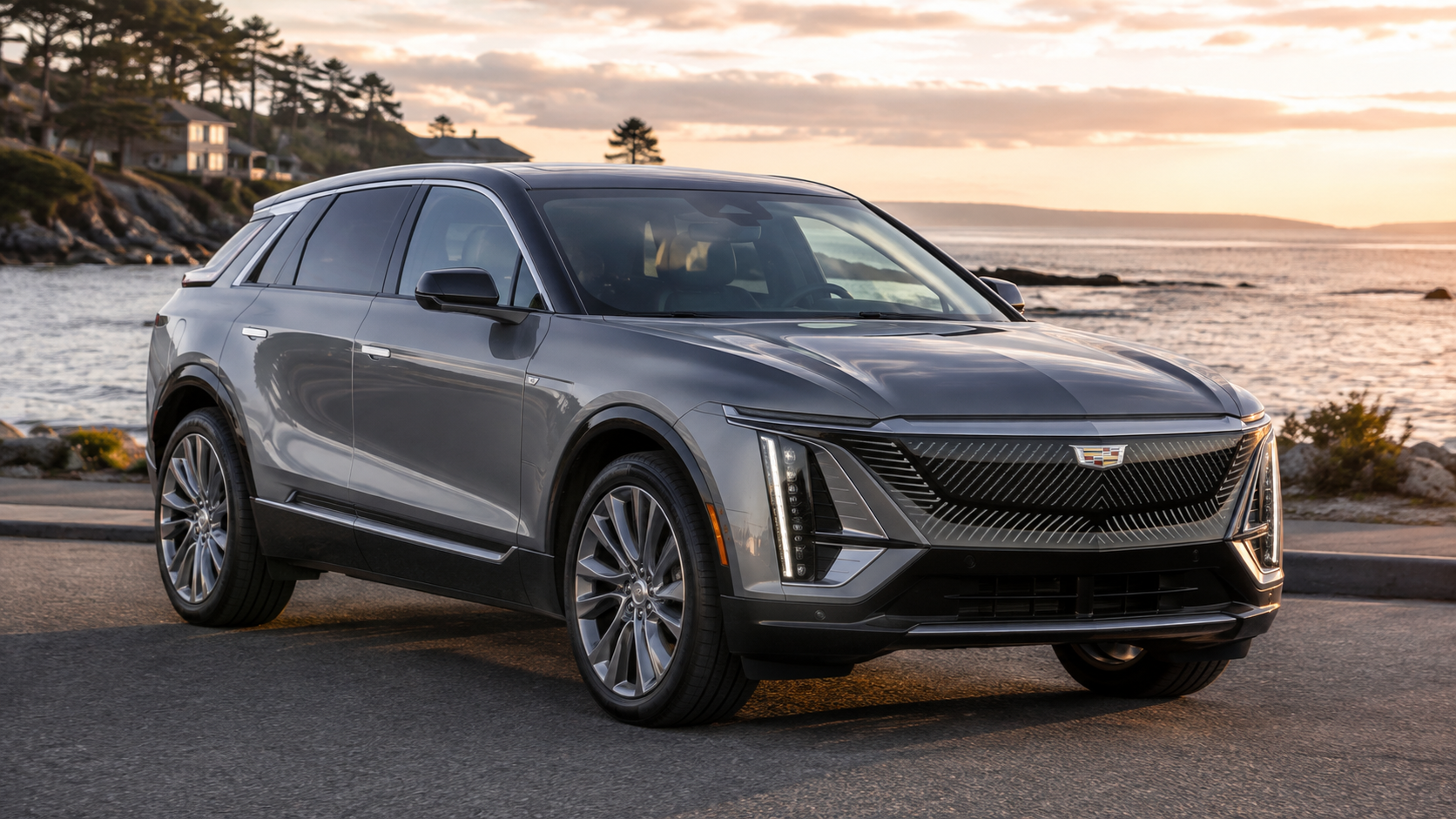
Quick Answer: Do LYRIQ Driving Modes Change Range?
Yes, indirectly. No, not through separate official range ratings. Cadillac does not publish one EPA range figure for Tour, another for Sport, and another for Snow/Ice or My Mode. Instead, the published range applies to the vehicle configuration, while the selected mode changes pedal tuning, handling, traction behavior and other systems that can affect how the stored energy is used.
In practical driving, Tour is generally the most sensible choice when consistent efficiency is the priority, while Sport can increase consumption when its sharper response encourages harder acceleration. Snow/Ice is intended primarily for slippery roads, and My Mode depends on the settings the driver chooses.
LYRIQ Battery and Official Range at a Glance
| Item | 2026 Cadillac LYRIQ |
|---|---|
| Vehicle type | All-electric luxury SUV |
| Battery rated energy | 102 kWh |
| Maximum RWD EPA-estimated range | Up to 326 miles |
| Maximum AWD EPA-estimated range | Up to 319 miles |
| Other AWD configuration | Up to 303 miles, depending on equipment |
| Standard drive modes | Tour, Sport, Snow/Ice, My Mode |
| LYRIQ-V performance mode | V-Mode and Velocity Max |
| Regenerative braking | Regen on Demand and One-Pedal Driving |
| Battery charging recommendation | Cadillac recommends 80% or less for routine daily use |
| Fast charging | Up to 86 miles of range in about 10 minutes under specified conditions |
Cadillac lists a 102 kWh battery for the LYRIQ and currently advertises up to 326 miles of EPA-estimated range for single-motor rear-wheel-drive models. Available dual-motor versions can reach up to 319 miles, while other configurations can have lower official ratings. These figures belong to the vehicle configuration, not to individual drive modes.
How LYRIQ Driving Modes Actually Work
Cadillac describes Driver Mode Control as a system that adjusts the overall driving experience. The 2026 owner’s manual says the available modes can include Tour, Sport, Snow/Ice, My Mode and V-Mode on V-Series models, with availability and affected vehicle systems depending on trim, region and equipment.
The modes therefore should not be viewed as four different battery-management programs. They are better understood as different vehicle-calibration profiles.
| Driving Mode | Cadillac’s Main Purpose | Potential Energy Effect |
|---|---|---|
| Tour | Smooth everyday city and highway driving | Usually the easiest setting for efficient, predictable driving |
| Sport | Sharper response, handling and acceleration | Can use more energy when stronger acceleration is used |
| Snow/Ice | Better traction on slippery roads | Prioritizes grip rather than maximum efficiency |
| My Mode | Driver-selected customization | Depends on the settings chosen |
| V-Mode | Custom dynamic performance on LYRIQ-V | Performance-focused settings can increase energy demand |
| Velocity Max | Maximum propulsion power delivery | Cadillac states extended use will reduce range |
Cadillac does not provide an official percentage saying, for example, that Sport always costs 10% of the battery or that Snow/Ice always reduces range by a specific amount. Such claims should therefore be treated cautiously unless they come from a controlled test of a specific vehicle under stated conditions.
Tour Mode and Energy Efficiency
Why Tour Is Usually the Best Starting Point
Cadillac describes Tour Mode as the setting for normal city and highway driving, emphasizing a smooth ride and a balance between comfort and handling. The 2026 owner’s manual does not label Tour as a dedicated “maximum range” mode, but its calibration makes it the natural everyday setting for drivers who want predictable acceleration and relaxed vehicle behavior.
That matters for energy consumption because electric vehicles can use substantially more electricity whenever the driver repeatedly demands strong acceleration. Tour’s smoother pedal behavior can make it easier to maintain a steady pace, but the actual efficiency still depends heavily on speed, traffic, temperature, road conditions, tire setup and driving style.
A driver who uses Tour aggressively can still consume more energy than someone who uses Sport gently. The selected mode is only one part of the overall energy equation.
Sport Mode and Battery Usage
Does Sport Mode Drain the LYRIQ Battery Faster?
Sport Mode can lead to higher energy consumption in real-world use, but Cadillac does not publish a fixed range penalty for it. The 2026 LYRIQ owner’s manual says Sport changes several characteristics, including steering effort, pedal tuning, electric-vehicle sound enhancement, adaptive cruise control and suspension tuning when equipped. It is intended to improve handling and acceleration on dry pavement.
The important distinction is between what the software changes and how the driver responds.
Sport makes the LYRIQ feel more immediate. If that encourages quicker launches, harder acceleration and more frequent performance driving, electricity is consumed faster. If a driver selects Sport but continues to accelerate gently and maintain moderate speeds, the difference can be much smaller.
That is why claims that Sport Mode automatically cuts range by a specific percentage are misleading. There is no universal number from Cadillac that applies to every LYRIQ in every driving situation.
Snow/Ice Mode Is About Traction, Not Maximum Range
Snow/Ice Mode is designed for a very different purpose. Cadillac says the mode adjusts pedal tuning to optimize traction on slippery surfaces and can also modify electric all-wheel-drive behavior. The owner’s manual specifically warns that its calibration can compromise acceleration on dry asphalt, which shows that its priority is controlled traction rather than performance.
It would therefore be incorrect to call Snow/Ice an “economy mode.” It may encourage gentler acceleration, which could sometimes reduce energy use, but that does not mean Cadillac engineered it as a range-maximizing setting.
In cold weather, the situation becomes more complicated. Low temperatures can affect battery performance and vehicle efficiency, while cabin heating, windshield defrosting and other electrical loads can increase consumption. In other words, a driver may notice lower range while using Snow/Ice in winter without the mode itself being responsible for all of that loss.
What Does My Mode Do?
My Mode is the LYRIQ’s customizable option. The 2026 owner’s manual says drivers can configure settings such as Acceleration Feel, Brake Feel, Steering, Suspension and Motor Sound, depending on vehicle content. Acceleration Feel can be configured with choices including Relaxed, Tour and Sport.
That makes My Mode particularly interesting from an efficiency perspective because there is no single “My Mode efficiency level.”
A driver can create a relatively relaxed setup that resembles Tour, or build a sportier configuration with sharper acceleration and firmer dynamic settings. Consequently, the energy effect of My Mode depends on the chosen configuration and, just as importantly, how the vehicle is driven.
Does Changing Modes Change the 102 kWh Battery?
No. Selecting Tour, Sport, Snow/Ice or My Mode does not change the LYRIQ’s physical battery capacity. The 2026 LYRIQ uses a battery system rated at 102 kWh, while the vehicle’s official range varies according to its drivetrain and configuration rather than because a driver selected a different standard driving mode.
Think of the battery as the same reservoir of stored energy. The drive modes influence how the vehicle responds and how certain systems operate, but they do not turn that reservoir into a larger or smaller battery.
The distinction between battery capacity, energy consumption and estimated range is essential. Battery capacity describes how much energy the vehicle can store. Consumption describes how much energy it uses to travel a given distance. Range is the resulting distance estimate based on available energy and consumption.
Why the Official Range Does Not Change With Every Mode
Cadillac’s published range figures are tied to vehicle configurations and standardized testing rather than a separate factory range certification for each driver-mode selection.
For the 2026 LYRIQ, Cadillac currently lists up to 326 miles for RWD models and up to 319 miles for certain AWD configurations. The manufacturer does not present those numbers as “326 miles in Tour” or “319 miles in Snow/Ice.”
This means drivers should not interpret the vehicle’s official EPA figure as a guaranteed distance in every mode or every environment. Actual range can vary with factors such as:
- Vehicle speed
- Outside temperature
- Road grade and terrain
- Wind
- Traffic
- Passenger and cargo weight
- Tire and wheel configuration
- Heating and air-conditioning use
- Acceleration habits
- Battery temperature
- Regenerative-braking use
Cadillac itself notes that actual EV range can vary with conditions, reinforcing the point that a single official figure cannot capture every real-world trip.
Regenerative Braking Is a Separate Part of the Equation
One common misunderstanding is that changing a drive mode automatically means the LYRIQ has radically different regenerative-braking behavior.
Cadillac treats Regen on Demand and One-Pedal Driving as dedicated EV features. One-Pedal Driving can be set to off, on or high, while the steering-wheel-mounted Regen on Demand paddle lets the driver control deceleration by varying pressure.
Regenerative braking converts some of the vehicle’s kinetic energy back into electrical energy. That recovered energy is stored in the battery and can help improve efficiency, especially in stop-and-go driving and situations involving repeated deceleration.
Because regeneration is a separate control system, it is not accurate to assume that selecting Sport automatically means regeneration is disabled or that Tour automatically creates dramatically more regenerative energy.
Can Regenerative Braking Increase LYRIQ Range?
Yes, regeneration can contribute to efficiency, but it should not be thought of as creating free energy.
When the LYRIQ slows through regenerative braking, part of the vehicle’s kinetic energy can be converted back into electrical energy. That is more efficient than relying exclusively on friction brakes, where much of the vehicle’s kinetic energy is converted into heat.
Cadillac recommends charging the battery to 80% or less for everyday use, partly because leaving additional capacity provides room for regenerative braking. For longer trips, Cadillac says the charge target can be raised when additional range is needed.
This is another reason the best real-world range strategy involves more than simply choosing a drive mode.
What About the Cadillac LYRIQ-V?
The LYRIQ-V deserves separate treatment because it adds performance-oriented controls that go beyond the standard LYRIQ lineup.
Cadillac’s 2026 LYRIQ-V uses a 102 kWh battery and is rated by Cadillac at 285 miles of EPA-estimated range. Its performance system includes V-Mode and Velocity Max, with the latter intended to maximize propulsion power delivery.
The owner’s manual is unusually clear about Velocity Max. It says the mode changes the pedal map, propulsion cooling, motor capability, motor sound and electric all-wheel-drive behavior, and explicitly states that extended usage will reduce the vehicle’s range. It is not designed for daily use.
That makes Velocity Max different from simply switching between Tour and Sport. Cadillac directly acknowledges the range consequence of sustained use because the feature is intended for maximum propulsion performance.
LYRIQ Drive Mode Comparison
| Mode | Main Objective | What Cadillac Changes | Range Interpretation |
|---|---|---|---|
| Tour | Comfortable everyday driving | Smooth driving calibration | Good default for predictable efficiency |
| Sport | Performance and handling | Pedal, steering and other dynamic settings | Can increase consumption when used aggressively |
| Snow/Ice | Slippery-road traction | Pedal tuning and eAWD behavior | Not designed as an efficiency mode |
| My Mode | Personalization | User-selected settings | Depends on configuration |
| V-Mode | LYRIQ-V dynamic customization | Performance-oriented settings | Can raise energy demand |
| Velocity Max | Maximum power | Propulsion, cooling, torque and AWD changes | Cadillac explicitly says extended use reduces range |
Which LYRIQ Mode Gives the Best Range?
There is no official Cadillac ranking of the standard modes by miles of range. Cadillac’s documentation describes what each mode is designed to do, but it does not provide a laboratory-tested miles-per-charge figure for Tour, Sport, Snow/Ice and My Mode individually.
For normal driving, Tour is the most logical efficiency-oriented choice because it is designed for smooth city and highway driving. However, driving technique remains more important than simply selecting a button.
A careful driver in Sport can potentially outperform an aggressive driver in Tour. Steady speeds, gentle acceleration, reasonable climate-control use and appropriate regenerative braking can have a larger practical impact than the mode label on the screen.
Also Read: OneWorldPlate Daniel Croteau | What the Evidence Shows
What Factors Affect LYRIQ Range More Than Driving Mode?
Speed
Highway driving at sustained high speeds generally requires more energy than slower mixed driving because aerodynamic resistance rises rapidly with speed. A driver looking for maximum range should therefore focus on maintaining an efficient, steady pace rather than assuming a particular drive mode will solve the problem.
Temperature
Battery and cabin thermal management are major parts of EV energy use. Cold weather can affect efficiency, while heating and defrosting can increase electrical demand.
Acceleration
Repeated hard acceleration can use considerably more electricity than gradual acceleration. This is one reason Sport Mode can have a real-world range effect even when the underlying battery capacity has not changed.
Climate Control
Heating, air conditioning and defrosting all consume energy. On a short trip, those auxiliary loads can represent a noticeable share of total electricity use.
Wheels and Vehicle Configuration
Official LYRIQ range varies by drivetrain and configuration. Cadillac’s current specifications show that RWD versions can reach higher range figures than some AWD variants, illustrating that hardware configuration has a meaningful impact.
Does Sport Mode Permanently Use More Battery?
No. Sport Mode does not permanently reduce the usable capacity of the LYRIQ battery simply because it has been selected. The difference is primarily in how the vehicle is calibrated and operated while that mode is active.
Using Sport for one drive does not mean the battery has somehow been damaged or permanently lost capacity. What matters is the energy consumed during the trip, along with the vehicle’s broader battery-management and charging behavior.
Likewise, selecting Tour does not permanently preserve a fixed percentage of the battery. Both modes ultimately draw from the same energy-storage system.
Can Snow/Ice Mode Save Battery?
Not as its primary purpose.
Snow/Ice Mode is designed to help control wheel spin and improve traction. Cadillac says it modifies pedal tuning and electric all-wheel drive for slippery conditions.
Because it encourages controlled acceleration, some driving situations may result in modestly lower power demand. But that should be treated as a possible consequence of the calibration, not as a factory range guarantee.
In cold weather, other factors can dominate the result. Cabin heating, battery temperature, road conditions and reduced traction may affect efficiency far more than the mode selection itself.
How to Get the Most Real-World Range From a LYRIQ
A sensible efficiency strategy looks beyond the drive-mode selector.
- Use Tour Mode for routine commuting and relaxed highway driving.
- Accelerate smoothly instead of repeatedly using maximum throttle.
- Maintain moderate, consistent highway speeds when practical.
- Use regenerative braking and One-Pedal Driving appropriately.
- Keep the battery charge target around 80% for regular daily use, as Cadillac recommends.
- Use higher charge levels before longer trips when additional range is required.
- Precondition the vehicle when appropriate, especially before demanding trips in extreme temperatures.
- Pay attention to tire pressure and other vehicle-maintenance basics.
- Avoid assuming that a particular drive-mode percentage applies to every LYRIQ.
Cadillac’s own charging guidance emphasizes the importance of an 80% daily target and notes that extra charge can be selected for longer journeys.
Common Claims About LYRIQ Driving Modes That Need Context
“Sport Mode cuts range by exactly 20%.”
There is no Cadillac-published figure establishing a universal 20% range reduction for Sport Mode. The actual effect depends on how the vehicle is driven, road conditions, speed, temperature and other factors.
“Snow/Ice Mode is the LYRIQ’s economy mode.”
That is incorrect. Cadillac identifies Snow/Ice as a traction-focused mode for slippery roads, not as a dedicated energy-saving setting.
“Changing modes changes the battery capacity.”
No. The LYRIQ’s battery does not physically become larger or smaller when the driver changes modes.
“Tour has a separate EPA range number.”
Cadillac does not publish separate EPA range ratings for Tour, Sport, Snow/Ice and My Mode. Its published figures correspond to the vehicle configuration.
“All performance settings have no effect on range.”
That is also too broad. Cadillac specifically states that extended use of Velocity Max on the LYRIQ-V will reduce range.
Frequently Asked Questions
Does Sport Mode reduce Cadillac LYRIQ range?
It can reduce real-world range when its sharper acceleration and performance calibration lead to higher energy consumption. Cadillac does not publish a fixed percentage range penalty for Sport Mode.
Which LYRIQ driving mode is best for range?
Tour is generally the most appropriate everyday choice for smooth, predictable driving. However, the driver’s speed, acceleration habits, temperature and climate-control use can have a larger impact on range than the mode itself.
Does Snow/Ice Mode use more battery?
Snow/Ice Mode is optimized for traction rather than maximum efficiency. Its energy effect varies with conditions, and cold weather can have a much larger impact on range than the mode selection alone.
Does My Mode affect battery consumption?
It can. My Mode allows the driver to customize acceleration feel, brake feel, steering and suspension settings, so its effect depends on the configuration and driving style.
Does LYRIQ-V Velocity Max affect range?
Yes. Cadillac’s 2026 owner’s manual explicitly states that extended use of Velocity Max will reduce range and says the feature is not designed for daily use.
Does changing drive modes change the LYRIQ’s battery size?
No. The battery’s rated energy remains the same. Drive modes alter vehicle behavior and system calibration, not the physical capacity of the battery.
The Bottom Line
The Cadillac LYRIQ does not have separate official range ratings for Tour, Sport, Snow/Ice and My Mode, and switching among those standard modes does not change the SUV’s physical battery capacity. What changes is how the vehicle responds, and that can influence real-world electricity consumption through acceleration, traction, vehicle calibration and driver behavior.
For most drivers, Tour is the sensible default for efficient everyday use, while Sport is best used when sharper response and handling are the priority. Snow/Ice should be selected when road conditions require extra traction, My Mode is useful for personalization, and LYRIQ-V owners should remember that Cadillac specifically warns that prolonged Velocity Max use reduces range.
The bigger lesson is that drive mode is only one variable in an EV’s range equation. Speed, temperature, terrain, tires, climate control, acceleration and regenerative braking all matter, so the most efficient LYRIQ is ultimately the one being driven smoothly and appropriately for the conditions.
Also Read: CnLawBlog Explained | Origins, Content, and Credibility