
Cal Henderson and Stewart Butterfield: The Team Behind Slack
November 11, 2026 · Editorial-Networks
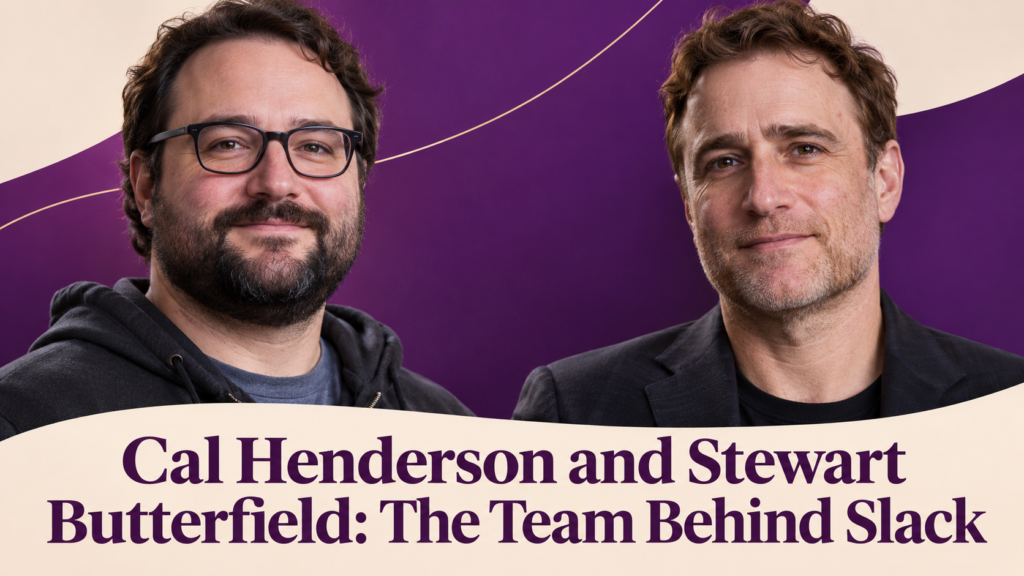
Cal Henderson and Stewart Butterfield share a documented professional connection: they are among Slack’s co-founders. Unlike a comparison based only on two names appearing together, this pairing has a clear company history behind it. Their story helps explain how a product can emerge from work originally intended for something else, and why founding a business is a team achievement.
The useful focus is not a contest over who deserves all the credit. Slack’s own account identifies more than two founders, while historical corporate records distinguish executive responsibilities from ownership. Understanding those distinctions gives readers a more accurate account of the company than a simplified story about a single person having a successful idea.
Cal Henderson and Stewart Butterfield: the verified connection
Slack’s account of its origins names Butterfield, Henderson, Eric Costello and Serguei Mourachov as co-founders. It describes the team’s decision to close its game project in 2013 and the communication needs that helped shape what became Slack. All four names matter to an accurate founder account.
A company’s origin story is useful, but it should not be treated as a complete technical or financial history. It explains how the business presents its beginnings. Other questions, such as ownership, executive appointments or a transaction’s terms, need the relevant corporate records. One source does not answer every possible question about a company.
A short timeline keeps different events separate
The game project’s closure in 2013 belongs to the product’s origin story. The later public-company period belongs to a different stage of institutional development. Salesforce’s acquisition belongs to another. Separating those stages prevents a writer from collapsing years of development, financing and organisational work into one dramatic moment.
Historical Slack reporting for the year ended January 2021 identifies Butterfield and Henderson’s then-executive roles. Such a filing is a dated record. It should not be copied into a current biography as if the titles necessarily remain unchanged.
Salesforce announced completion of the Slack acquisition in July 2021. A completed acquisition is different from an earlier agreement to acquire. The distinction matters because a proposed transaction can still have conditions to satisfy before ownership changes.
What a pivot actually means
A pivot is a change in business direction, often using something learned or developed during an earlier effort. It does not mean that the original project secretly succeeded in its initial purpose. The interesting question is what remained useful after the team recognised that its first plan would not continue.
In software, an internal tool can reveal a recurring problem that other organisations might also have. However, a tool that works for its creators is not automatically ready for outside customers. It needs an understandable interface, dependable operation and support for people who do not share the original team’s assumptions. Recognising the opportunity is only part of the work.
This is why origin stories should include execution as well as discovery. A product must be built, explained and maintained. Users need reasons to adopt it and continue using it. A memorable moment can make the story easy to tell, but the organisation’s sustained work is what turns the idea into something customers can rely on.
Engineering and product direction belong together
A communication service needs both useful behaviour and reliable underlying systems. Product direction concerns what people need to do and how the experience should work. Engineering concerns making that experience function under real conditions. Neither can be reduced to decoration around the other; both affect whether a customer can use the service effectively.
Historical executive titles help distinguish formal responsibilities, but they do not reveal every contribution made inside a team. A chief technology officer may have a particular leadership remit, while a chief executive has wider organisational responsibility. Actual work also involves many specialists whose names may not appear in a short founder profile.
Readers should therefore avoid a false choice between the “idea person” and the “technical person”. Successful software development usually requires decisions to move between user needs, implementation constraints and commercial requirements. The documented relationship between Henderson and Butterfield is more interesting as collaboration than as a simplified rivalry.
Why workplace communication is an organisational problem
A tool can make communication easier, but it cannot decide every norm for a workplace. Teams still need to agree where decisions belong, how information is organised and when a message requires a response. Without those practices, adding a new communication channel can create more material without making important information easier to find.
This distinction helps readers evaluate product claims. A feature can enable a workflow without guaranteeing that every organisation will use it well. Suitability depends on the team’s tasks, policies and existing systems. Current decisions about Slack should therefore use current product documentation and organisational requirements, not only the company’s founder story.
Founding a company is not the same as owning all of it
Founders can share ownership with one another, employees and investors. Different share classes and later transactions can affect financial and voting rights. A company’s value should not be assigned entirely to one founder without examining those arrangements. The word “co-founder” establishes a historical role, not a complete personal balance sheet.
An acquisition headline creates another common misunderstanding. The overall transaction value is not automatically the amount a named founder received. Individual proceeds depend on holdings and deal terms, while personal net worth also involves other assets and liabilities. This article therefore does not turn the Slack transaction into an unsupported wealth ranking between Henderson and Butterfield.
What the story teaches without promising a formula
The transferable lesson is to examine what a team has learned, not to assume every unsuccessful project contains a valuable hidden product. A change of direction still needs evidence of a real customer problem and the ability to serve it. Survivorship can make successful pivots look inevitable after the outcome is known.
For related reading on online communities and communication, Khatrimazacool’s guides to r/Popheads discussion and Reddit update-story communities examine other settings in which people organise information. They are contextual comparisons, not claims that those communities are Slack products or partners.
Learning from internal use has limits
An internal team understands its own language and habits. Outside customers may not share that context, so a product has to explain itself more clearly. Information that seems obvious to the creators can be confusing to a new user. This is one reason moving from an internal tool to a commercial service involves more than making the same screen available to everyone.
The team also needs to learn from people whose work differs from its own. Feedback can reveal problems in organisation, usability or administration that the original group never encountered. This does not make the founding insight less valuable. It shows why ongoing product work matters after the origin story ends. Readers can appreciate the creative change of direction while recognising that the later business required a separate effort to serve a wider set of users reliably.
That wider effort is part of the achievement. It turns a useful insight into an organisation capable of supporting people who were never part of the original founding team’s working environment.
Frequently asked questions
Did Cal Henderson and Stewart Butterfield work together?
Yes. Slack identifies both among its co-founders, alongside Eric Costello and Serguei Mourachov.
Did Slack emerge from a game project?
Slack’s own origin account describes a game project that closed in 2013 and the team’s communication needs that helped shape the later product.
When did Salesforce complete the acquisition?
Salesforce announced completion in July 2021. That completed event should be distinguished from the earlier acquisition agreement.
Does a co-founder remain CEO indefinitely?
No. Founding is a historical relationship, while executive positions can change. Current roles need current verification.
Was the full acquisition value paid to one founder?
A company’s transaction value is not automatically an individual founder’s proceeds. Ownership interests and transaction terms determine how consideration is distributed.
Leave a Reply