
GDTJ45 Builder Software Code Development: Change Control
November 6, 2026 · Editorial-Networks
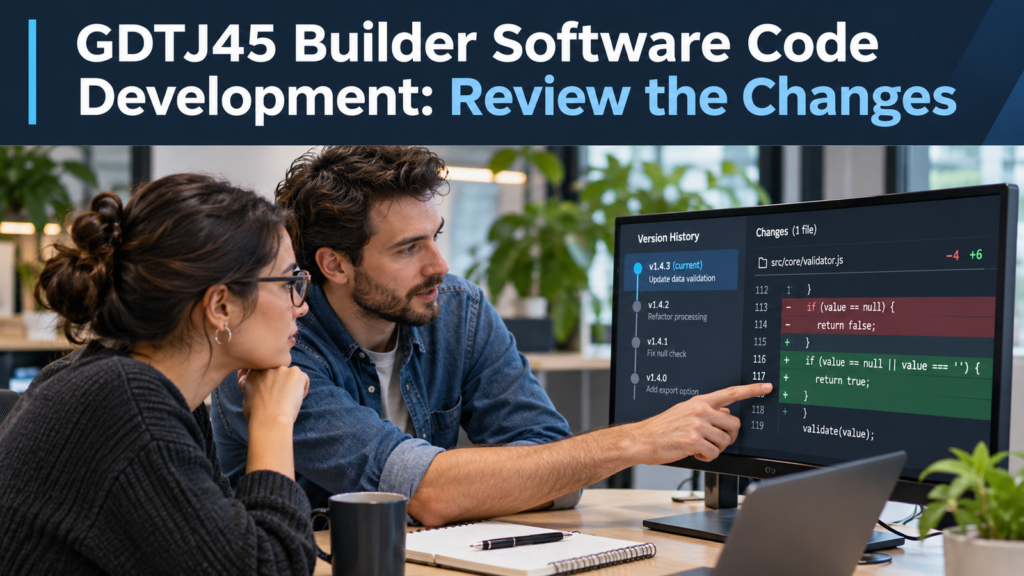
GDTJ45 Builder Software Code Development does not have a verified public development specification in the sources checked for this article. If the phrase appears in a project brief, begin by identifying the actual tool and source repository before treating claims about its capabilities as established facts.
The practical issue examined here is change control: how a team decides which proposed modification should reach users and what evidence supports that decision. These are general development practices, not undocumented instructions for a product called GDTJ45. They are especially useful when a project changes hands or several people contribute at once.
Give Each Change a Reason Someone Can Assess
A change should begin with a concrete problem. A request such as “improve the dashboard” leaves the developer and reviewer guessing about success. “Show the last completed import time beside its status” identifies a behavior that can be demonstrated.
Write down the trigger, present behavior and intended result. Add an example using invented sample data clearly labeled as such. This creates a shared reference when people later disagree about whether a modification solved the original problem.
Keep unrelated requests separate where practical. A label correction and a new account-permission system require different review effort and carry different implications. Combining them into one large submission makes the simple correction wait for a much larger discussion and makes faults harder to trace afterward.
What GDTJ45 Builder Software Code Development Must Identify First
An unfamiliar label is not enough to establish what is being developed. Request the actual project location, responsible maintainer, supported runtime and existing release information. If those cannot be supplied, retain the uncertainty rather than filling the gap with assumptions about languages or visual builders.
A website using a related name is not automatically the publisher of a downloadable development tool. Likewise, an article describing impressive features is not a technical specification. Connect each important claim to evidence that belongs to the project under discussion.
For background, the site’s GDTJ45 project-portability guide considers the evidence needed to understand ownership and exports. Change control begins after that identity work: reviewers must know which source and which deployed result their decision concerns.
Choose a Review Boundary That Makes Sense
A useful submission is large enough to solve one defined problem and small enough for a reviewer to understand. This is a judgment about behavior, not an arbitrary number of changed lines. A short configuration change can affect every user, while a longer documentation edit may have limited operational effect.
Describe what the reviewer should inspect first. If the change affects a visible report, provide a sample of the old result and the proposed result. If it changes how records are interpreted, show the input that previously produced the wrong answer.
GitHub’s pull request review documentation describes commenting, approval and requests for changes before merging. That is an example of a documented review mechanism, not evidence that an unidentified GDTJ45 project uses GitHub or supports the same workflow.
Separate “Looks Correct” From “Works Under the Trigger”
A screenshot can establish that a label is readable. It cannot establish that the value updates at the right time or belongs to the correct account. Review evidence should match the claim being made.
Consider a hypothetical task list where completed items occasionally reappear. The useful demonstration is a sequence: complete a sample item, refresh the list and reopen the application. A single screenshot of the completed state leaves the reported trigger untested.
Write down the expected result before running the check. This reduces the temptation to accept whichever output happens to appear. Include the important awkward case, such as an empty list or a record the current user cannot edit, when it changes the reviewer’s decision about the fix.
Keep Decisions Beside the Work They Explain
Development conversations often become difficult to reconstruct because the reason for a change lives in one chat and its implementation lives somewhere else. Preserve a concise decision where future maintainers can find it from the relevant work item or source revision.
The note should explain the chosen behavior and any meaningful limit. “Retain the last completed import time when the next attempt fails” is more useful than “fixed status issue.” It tells a later maintainer why a value remains visible after an error.
Tools can help organize this record. GitHub Projects, for example, connects planning views with issues and pull requests. Whatever system a team uses, the objective is the same: make the relationship between the reported problem, proposed change and review decision easy to follow.
Approve a Release, Not an Unnamed Collection of Files
An approval should identify the version that was actually examined. Otherwise, a developer may add further changes after review and unintentionally ship work that nobody assessed. Keep the reviewed revision, release description and deployment record connected.
GitHub’s release documentation explains releases based on repository tags and the use of release notes and downloadable assets. This gives a concrete example of versioned distribution, while leaving other projects free to use a different documented mechanism.
For a small team, a release note can remain short. Explain the user-visible change, any action the operator needs to take and a material known limitation. Avoid copying a long internal discussion into the release note when a clear account of the final behavior will serve readers better.
Plan What Happens if the Change Is Rejected
Review is only useful when rejection is an ordinary possible outcome. A reviewer may find that the proposed fix handles the example but changes a related behavior that users rely on. That observation should return the work to revision with a clear explanation.
Ask for specific evidence rather than vague reassurance. “Show what happens when the imported list is empty” gives the author a concrete next step. “Make this more robust” does not identify the missing behavior or the test that would resolve the concern.
The same principle applies after release. Decide who receives a report and how they identify the affected version. For problems involving saved versus visible state, the related guide to output-state investigation offers a different diagnostic perspective. A release record helps connect that report to the actual change.
Make the Process Proportionate to the Team
A two-person project does not need an elaborate approval ceremony for every spelling correction. It does need enough discipline to distinguish a harmless edit from a change to money, permissions or stored records. Scale the review to the consequence and the uncertainty.
One person can prepare the change while another checks the relevant behavior. If a person works alone, a written acceptance example and a deliberate second review still make the decision clearer. Do not claim independent review when the same person performed both roles.
The most useful process leaves a readable trail: why the work existed, what changed, what was checked and which version reached users. That trail is an outcome in its own right because it makes the next fault or enhancement less dependent on somebody’s memory.
Frequently Asked Questions
Is GDTJ45 a verified coding framework?
This review did not establish authoritative documentation for a framework under the exact name. Verify the real project before relying on language support or feature claims.
Does every change need a pull request?
No particular hosting workflow is mandatory here. A pull request is one documented way to collect changes and review decisions; another system can serve the same purpose.
What is the most useful review evidence?
Evidence that reproduces the reported trigger and demonstrates the intended result. Match the check to the behavior rather than supplying screenshots that answer a different question.
Can a release note replace testing?
No. A release note explains what is being distributed. Verification establishes whether the relevant behavior was demonstrated before distribution.
What should a small team record?
Record the problem, reviewed revision, meaningful checks, release identifier and responsible contact. Add detail when it helps someone assess a decision or investigate a later report.
Leave a Reply