Software GDTJ45 Builder Does Not Work: Where Did My Changes Go?
November 5, 2026 · Editorial-Networks
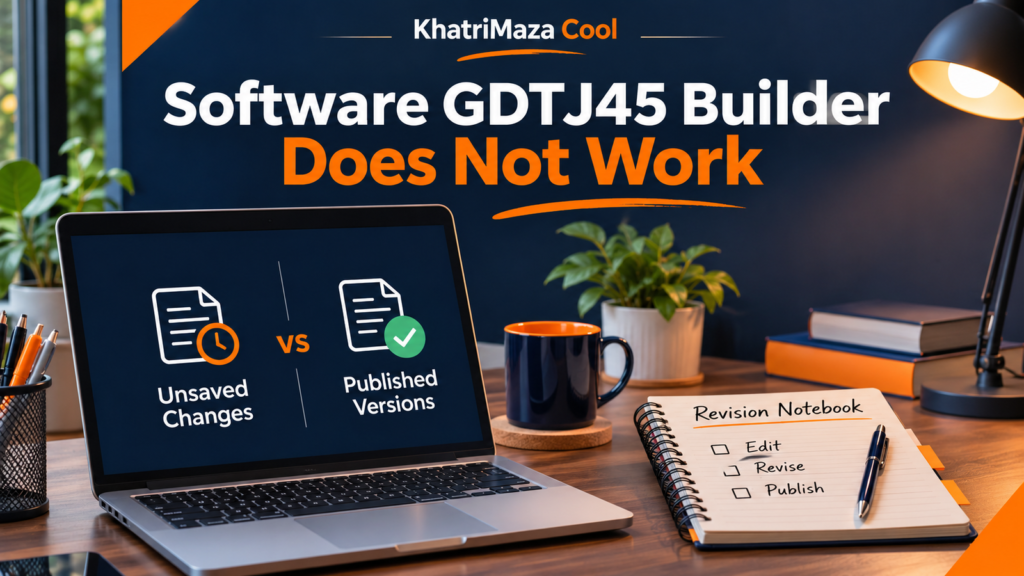
If Software GDTJ45 Builder Does Not Work describes edits that disappeared or never appeared publicly, investigate the saving and publication stages separately. No authoritative GDTJ45 product manual was verified, so this guide does not assume the tool provides autosave, revision history or a particular publishing button.
A visible edit, a saved project and a published page can represent different states in a documented editor. Confusing them can make correct behavior look like lost work, while a real failed save can remain unnoticed. The useful task is to identify the last state your actual application confirmed.
This is a guide to preserving evidence and understanding state, using hypothetical editor scenarios. It is not a confirmed repair for an identified GDTJ45 release. Follow your real application’s supported instructions and avoid discarding an open session before recording what remains visible.
Establish What Software GDTJ45 Builder Does Not Work Means Here
Describe the edit you made and where you expected to see it. Was it missing after reopening the project, absent from a preview or absent from a public page? Those observations concern different boundaries and should be written separately.
Record the actual application, project identity and responsible publisher or internal team. If GDTJ45 is only a phrase found in an article, first identify the editor you are using. An unfamiliar search label cannot supply the application’s save semantics.
Use a small example in the description. Changed the screening time from six to seven, but the public page still says six gives an investigator a concrete comparison. The whole website is broken does not identify what changed or where.
Preserve the Open State Before Refreshing
If unsaved work remains visible, use the application’s documented save or export route where available. If no such route is established, record the visible text and relevant screen context before closing or refreshing. Do not promise that a screenshot captures a complete editable project.
Avoid making many additional edits while determining whether saving works. More changes can complicate the comparison between the visible state and the last confirmed stored state. Keep a note of the specific edit under investigation.
If the application displays an error, preserve its wording. A message about permission, a disconnected session or invalid content is more informative than an assumption that the editor forgot the work. The correct next step depends on that evidence.
Distinguish Editing, Saving, Previewing and Publishing
An editor may display a local change before storing it. A preview may display a draft that is not public. Publication may create another state visible to visitors. These are common workflow concepts, not features verified for GDTJ45.
Check the actual documentation for the application you have identified. Ask what action confirms a save and what action updates public output. A visible checkmark or status label only has the meaning the product assigns to it.
For a documented comparison, WordPress explains saving and publishing posts. That example illustrates why draft and public states should be distinguished. It does not establish that another builder follows WordPress’s interface or storage behavior.
Verify That You Are Looking at the Same Project
Similar project titles, duplicate files and different workspaces can create an apparent loss. Record the project identifier or documented location, not only its display name. Compare the editor’s context with the destination where you expected the change.
A hypothetical team could have a staging copy and a public copy with identical titles. Editing one would not necessarily update the other. That is a possible explanation to check, not a diagnosis established by a matching screen appearance.
Ask the responsible administrator how the environments relate. Do not merge or delete copies simply to make the list less confusing. Preserving distinct identities is important until you understand which one contains the authoritative work.
Check Whether the Session Still Has Authority to Save
An interface can remain visible while the underlying account session or permissions change. If your real application reports a sign-in or permission problem, use its supported account route. Do not assume that being able to type proves the account can store the result.
Note whether the issue affects one user or every authorized editor. That scope can help the administrator decide what to investigate. Avoid sharing account credentials so another person can imitate your session; use the service’s approved collaboration methods.
If a colleague successfully saves, compare the documented role and project access rather than immediately changing unrelated settings. The observation narrows the question, but it does not establish the precise cause without further evidence.
Compare Stored Content With Public Output
After a documented save, reopen through the supported route and check the small edit. If the stored project contains the new text but the public output does not, the remaining investigation concerns the path from stored state to publication.
If the stored project still has the old text, focus on whether the save completed and which project received it. These two results should not be treated as the same failure. Record each separately so support can reproduce the relevant stage.
Do not repeatedly publish a large project merely to test one sentence. Where the actual tool supports a safe sample or preview workflow, use it. Public changes should remain intentional, and a test should have a clear expected result.
Treat History and Recovery Features as Product-Specific
A real editor may offer revision history, recovery files or another documented mechanism. Check its scope before using it. A revision could cover page text while leaving external records or attachments unchanged.
WordPress’s revision documentation provides an identifiable example of how a platform describes stored changes. It should not be read as a promise that GDTJ45 has revisions or that another application’s recovery works identically.
If a recovery action would replace current work, preserve the available state first and ask the responsible owner about consequences. Restoring an earlier view can recover one item while removing newer changes elsewhere. Understand the boundary before proceeding.
Avoid Conflicting Edits During the Investigation
If several people are editing, agree who will test the affected item and when. Record the relevant changes and avoid simultaneous experiments on the same project. Otherwise, a successful save may be overwritten by another authorized action and look like a random disappearance.
This does not assume your application supports or rejects concurrent editing in any particular way. Ask its documentation how conflicts are handled. Some workflows require explicit coordination even when multiple users can open a project.
Our support-report guide offers related context for documenting a sequence without assigning blame. A clear timeline helps distinguish product behavior from overlapping actions.
Define Recovery Against the Original Edit
The issue is resolved when the intended change is stored in the correct project and appears in the correct output after the documented publication process. A successful login or missing error banner does not demonstrate that result.
Record the small test, its outcome and any remaining limitation. If you recovered text manually rather than restoring a project, say so. That distinction matters for attachments, configuration and other work not captured by the text copy.
For broader launch problems, our launch-testing article addresses a different stage. Keep a saving problem focused on state and publication rather than applying unrelated runtime changes.
Frequently Asked Questions
Does GDTJ45 definitely have autosave?
No autosave capability was verified. Consult the actual application’s documentation and look for its defined confirmation of stored work.
Why can an edit appear in preview but not publicly?
Some documented workflows distinguish drafts and published output. Confirm whether that distinction applies to your actual editor before diagnosing a failure.
Should I refresh immediately if an edit seems stuck?
First preserve visible work and any error message through appropriate supported means. Refreshing may change the state available for investigation.
Can another editor overwrite my change?
That depends on the product’s collaboration behavior. Coordinate testing and consult its documented conflict-handling rules instead of assuming either outcome.
What proves that work has been recovered?
Verify the intended content in the correct stored project and final destination. State which elements were restored and which remain unconfirmed.
Comments
- Pingback: What Are Try and Except in Python 2579xao6? File Recovery