
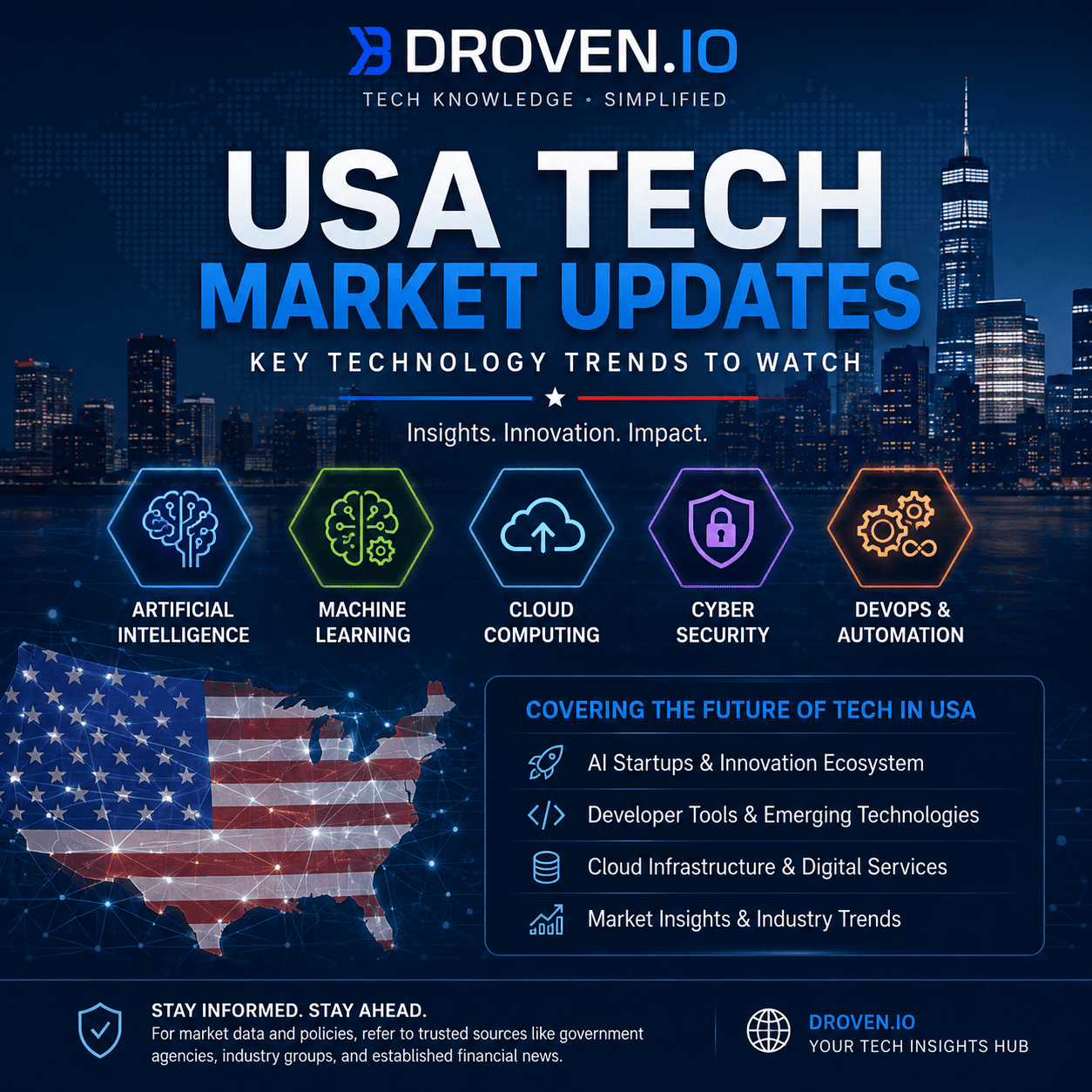
Droven.io covers major areas of the U.S. technology market, including artificial intelligence, cloud computing, cybersecurity, DevOps, automation, and emerging technologies. Current market evidence shows that AI infrastructure, semiconductors, data centers, cybersecurity, and quantum computing are among the most important areas to watch.
What Is Droven.io?
Droven.io is described online as a technology knowledge hub focused on explaining complex technology topics in simple language. Its coverage includes artificial intelligence, machine learning, cloud computing, cybersecurity, DevOps, automation, and technology trends in the USA.
The platform also presents information about AI startups in the USA, developer technologies, cloud infrastructure, and emerging digital services. This makes the Droven.io USA tech market updates topic relevant to readers looking for a broad view of the technology sector.
However, readers should separate Droven.io’s own descriptions and market commentary from independently published data. Government agencies, industry groups, and established financial news organizations provide stronger sources for market statistics and policy developments.
Why the U.S. Tech Market Is Changing Quickly
The United States technology market is being shaped by several connected developments. Artificial intelligence is increasing demand for advanced chips, cloud services, data centers, software, networking equipment, and electricity.
At the same time, businesses are placing greater attention on cybersecurity, automation, software reliability, and digital infrastructure.
The U.S. government is also identifying AI, quantum technologies, biotechnology, and semiconductors as important critical and emerging technology areas. NIST says these fields are central to efforts to strengthen American innovation and industrial competitiveness.
This creates a technology market where software, hardware, energy, and security are becoming more closely connected.
Artificial Intelligence Remains the Main Technology Trend
Artificial intelligence continues to be one of the most important forces in the U.S. technology market.
AI is moving beyond simple chatbots and content tools. Businesses are adopting AI for automation, software development, data analysis, customer service, cybersecurity, industrial processes, and decision support.
NIST’s current technology strategy specifically highlights the development and adoption of AI-driven autonomous agents and AI systems that can support U.S. manufacturing and protect critical infrastructure from cyber threats.
The U.S. Government Accountability Office also identifies AI competitiveness as an important national issue, with AI affecting economic growth, social outcomes, and national security.
AI Agents and Business Automation
One important shift is the move from AI that only generates answers toward AI systems that can perform tasks.
AI agents can potentially:
- Process business information
- Automate repetitive workflows
- Connect different software systems
- Assist employees with research
- Monitor processes
- Support customer service
- Analyze large amounts of data
This trend is closely related to the automation and DevOps topics covered by Droven.io.
The market is increasingly focused on whether AI can produce measurable improvements in productivity, cost control, accuracy, and speed, rather than simply demonstrating new capabilities.
AI Infrastructure and Data Centers
The growth of AI is also creating a major expansion in computing infrastructure.
Modern AI workloads require large numbers of powerful processors and advanced data center systems. This is increasing demand for GPUs, memory, networking equipment, cooling systems, cloud computing, and data center capacity.
Recent market reporting shows continued investor interest in companies involved in AI infrastructure, semiconductor production, and hyperscale cloud services. Reuters reported in August 2026 that strong cloud growth and continuing capacity constraints were keeping attention on AI infrastructure and major cloud providers.
The energy requirements of this infrastructure are also becoming a major technology market issue.
The U.S. Department of Energy says large AI data centers are becoming some of the most dynamic new electricity loads because AI training facilities can use thousands of specialized chips operating together.
Cloud Computing Is Moving Toward AI-Ready Infrastructure
Cloud computing remains a major part of the U.S. technology market. The next phase is increasingly connected to AI workloads, data processing, automation, and scalable infrastructure.
Businesses continue to use cloud platforms for:
Data storage, software deployment, application hosting, analytics, security, and AI services.
The market is also moving toward flexible infrastructure models that can combine public cloud, private systems, hybrid environments, edge computing, and specialized AI infrastructure.
Recent technology market coverage points to strong demand for cloud capacity because organizations need infrastructure capable of supporting rapidly expanding AI applications.
Edge Computing and Real-Time Processing
Edge computing is another important area to monitor.
Traditional cloud systems often send data to centralized data centers. Edge computing processes more information closer to the device or user.
This can be useful for:
| Technology Area | Potential Benefit |
|---|---|
| Industrial systems | Faster machine responses |
| Connected devices | Lower communication delays |
| Smart infrastructure | Faster local data processing |
| Healthcare technology | Near real-time processing |
| Autonomous systems | Quick decision support |
| Retail technology | More responsive customer systems |
The continued growth of connected devices and AI applications could increase the importance of local computing and distributed infrastructure.
Semiconductors Are Becoming More Strategic
Semiconductors are at the center of the U.S. technology market because almost every major digital system depends on them.
The Semiconductor Industry Association reported in July 2026 that global semiconductor sales reached a record $795.6 billion in 2025. It also cited a WSTS projection for global sales of about $1.5 trillion in 2026. The growth is linked to AI, advanced computing, communications, healthcare, defense, and other technology applications.
The U.S. government is also focused on semiconductor supply chains.
A January 2026 White House action stated that the United States has relied heavily on foreign sources for semiconductor manufacturing and identified domestic semiconductor capacity as important to economic and national security.
Why Chip Manufacturing Matters
The semiconductor market affects:
AI systems, smartphones, computers, cloud data centers, automobiles, telecommunications, medical devices, and defense technology.
This means chip availability can influence the wider technology market. Supply chain disruptions, manufacturing capacity, advanced packaging, and access to high-performance processors will remain important issues.
Cybersecurity Is Becoming More Closely Linked to AI
Cybersecurity is another major trend within the U.S. technology market.
As businesses adopt more software and connected systems, they also face growing risks from phishing, ransomware, identity attacks, data theft, software vulnerabilities, and attacks against critical infrastructure.
At the same time, AI is being used on both sides of cybersecurity. Security teams can use AI to identify unusual activity and support threat analysis, while attackers can use automated tools to improve the scale and speed of some attacks.
NIST continues to focus on areas such as AI security, identity and access management, privacy, trusted networks, cryptography, and cybersecurity risk management.
AI Security and Critical Infrastructure
The connection between AI and cybersecurity is becoming especially important for government agencies and critical infrastructure.
A June 2026 White House fact sheet said federal policy is focused on strengthening cybersecurity and promoting access to AI-enabled cybersecurity tools for government organizations and critical infrastructure operators.
This suggests that future technology markets will increasingly evaluate AI products not only for performance but also for security, reliability, privacy, and resilience.
DevOps and Software Automation
DevOps remains important because organizations need to release software faster while maintaining reliability.
Modern DevOps practices commonly involve:
Continuous integration, continuous delivery, automated testing, infrastructure as code, monitoring, and security controls.
Droven.io also discusses technologies such as Jenkins, GitHub Actions, Terraform, AWS, and container-based cloud infrastructure as part of its technology coverage.
The relationship between DevOps and AI is also becoming stronger. AI tools can assist developers with code generation, testing, documentation, monitoring, and troubleshooting.
However, automated software development still requires human review, security testing, and proper access controls.
Quantum Computing Is Moving Toward Commercial Development
Quantum computing remains an emerging technology rather than a mainstream replacement for traditional computing. However, U.S. investment and research activity make it an important long-term trend.
In May 2026, the U.S. Department of Commerce announced letters of intent for about $2.013 billion in federal incentives supporting quantum companies and domestic quantum manufacturing capabilities. The initiative covers areas such as quantum computing, quantum foundries, advanced components, and manufacturing.
NIST also announced a new Quantum Manufacturing Engineering Center in June 2026 to help accelerate the manufacturing of scalable quantum components and systems.
Potential applications for quantum technology include:
| Area | Possible Application |
|---|---|
| Drug discovery | Advanced molecular simulation |
| Finance | Complex modeling and optimization |
| Materials science | New material research |
| Energy | Optimization and system modeling |
| Cybersecurity | Advanced cryptography and security |
| Sensing | Highly sensitive measurement systems |
The technology is still developing, so commercial impact should be measured carefully rather than assumed.
Data Centers and Electricity Demand
One of the less visible technology trends is the growing relationship between computing and energy infrastructure.
AI data centers require significant electricity. The U.S. Department of Energy’s updated analysis estimates that U.S. data centers could account for approximately 11.8% of total U.S. electricity use by the end of the decade, with modeled scenarios ranging from 9.5% to 15.3%.
The issue goes beyond electricity generation. Technology companies and utilities also need:
Transmission capacity, grid reliability, cooling systems, backup power, and efficient energy management.
DOE’s 2026 draft National Transmission Needs Study specifically points to hyperscale AI data centers and domestic manufacturing as drivers of rising electricity demand and the need for additional transmission infrastructure.
This means future USA tech market updates will increasingly include energy infrastructure alongside traditional technology news.
Advanced Communications and Connected Technology
Another area worth watching is advanced wireless communication.
The growth of AI, connected devices, autonomous systems, industrial automation, and smart infrastructure increases demand for faster and more reliable networks.
NIST identifies next-generation communications among the technology areas relevant to U.S. innovation and competitiveness. Its broader strategy also connects communications with areas such as semiconductors, AI, quantum technology, and advanced manufacturing.
The development of new wireless technologies will support applications that depend on:
Low latency, high bandwidth, device connectivity, and reliable data transmission.
Startup Funding and the U.S. AI Ecosystem
The U.S. startup market remains strongly connected to artificial intelligence.
AI startups are attracting attention across sectors such as:
Enterprise software, healthcare, cybersecurity, robotics, developer tools, fintech, and data infrastructure.
At the same time, market participants are becoming more selective. Recent reporting shows investors continue to favor AI infrastructure and major technology companies while paying closer attention to capital spending, profitability, cash flow, and long-term business value.
For readers following Droven.io USA tech market updates, this is an important distinction. A technology company may attract large funding rounds without having a proven commercial model. Market analysis should therefore consider revenue, customers, product adoption, infrastructure costs, and competitive position.
Key USA Technology Trends to Watch
| Trend | Why It Matters | Market Areas Affected |
|---|---|---|
| Artificial Intelligence | Drives software and automation growth | AI, SaaS, enterprise technology |
| AI Infrastructure | Creates demand for computing capacity | Data centers, chips, cloud |
| Semiconductors | Supports almost every digital system | Computing, AI, telecom, defense |
| Cybersecurity | Protects growing digital infrastructure | Software, government, enterprise |
| Cloud Computing | Provides scalable digital infrastructure | SaaS, AI, data services |
| Quantum Computing | Supports long-term advanced computing research | Science, finance, security |
| Data Center Energy | AI increases electricity requirements | Utilities, grids, infrastructure |
| DevOps Automation | Improves software development processes | Engineering, cloud, cybersecurity |
| Advanced Communications | Supports connected devices and services | Telecom, IoT, industrial systems |
What Businesses Should Watch in the U.S. Tech Market
Businesses following technology market developments should pay attention to measurable changes rather than technology headlines alone.
Important indicators include AI adoption rates, cloud spending, semiconductor supply, data center construction, cybersecurity incidents, venture funding, software productivity, and technology regulation.
It is also useful to track the relationship between technology and infrastructure. AI growth, for example, affects not only software companies but also chip manufacturers, cloud providers, power utilities, networking companies, cooling suppliers, and construction firms.
This wider view provides a better understanding of the U.S. technology ecosystem.
How Droven.io Fits Into Technology Market Research
The main value of a platform such as Droven.io is its broad coverage of technology subjects in one place. Its published material connects AI, cloud computing, cybersecurity, DevOps, automation, and emerging technology with the wider U.S. market.
For reliable market research, however, Droven.io content should be combined with primary sources.
Useful sources include:
NIST for technology standards and cybersecurity, U.S. Department of Energy for energy and data center information, U.S. Government Accountability Office for technology policy analysis, U.S. Department of Commerce for semiconductor and quantum initiatives, and established financial news organizations for market and investment developments.
This approach helps readers distinguish between technology commentary, market forecasts, official data, and verified announcements.
Also Read: KhatriMaza | Latest Movies, Web Series, Features & Safety Guide (2026)
Frequently Asked Questions About Droven.io USA Tech Market Updates
What are Droven.io USA tech market updates?
Droven.io USA tech market updates refers to technology-related information focused on the United States market, including AI, cloud computing, cybersecurity, DevOps, automation, startups, and emerging technologies. Droven.io describes itself as a technology knowledge hub covering these subjects.
What is the biggest U.S. technology trend right now?
Artificial intelligence is one of the biggest technology trends because it is influencing software, chips, cloud computing, data centers, cybersecurity, and business automation. U.S. government strategy and private-sector investment both show strong attention to AI development and deployment.
Why are semiconductors important to the U.S. tech market?
Semiconductors power computers, AI systems, communications equipment, vehicles, medical devices, and many other products. Their strategic importance has increased because the growth of AI and advanced computing requires large quantities of high-performance chips.
Will AI increase data center demand?
Yes. AI workloads require substantial computing resources, which increases demand for data centers, advanced processors, networking equipment, and electricity. DOE research shows that expanding data center activity is becoming an important factor in U.S. electricity demand.
Is quantum computing already mainstream?
No. Quantum computing is still an emerging field. However, U.S. investment in quantum research, manufacturing, and commercial development indicates that it is considered an important long-term technology area.
Why is cybersecurity important for AI businesses?
AI systems handle valuable data and may interact with business software and critical infrastructure. This creates security requirements around data protection, identity management, software security, system reliability, and AI-specific risks. NIST continues to develop guidance related to cybersecurity and AI.